
How Do Bees Make Honey? The Step-by-Step Science of Nectar Conversion
The process of transforming watery flower nectar into the shelf-stable, viscous substance we know as honey is a remarkable feat of collective labour and biological chemistry.
Here is the step-by-step breakdown of how honeybees achieve this:
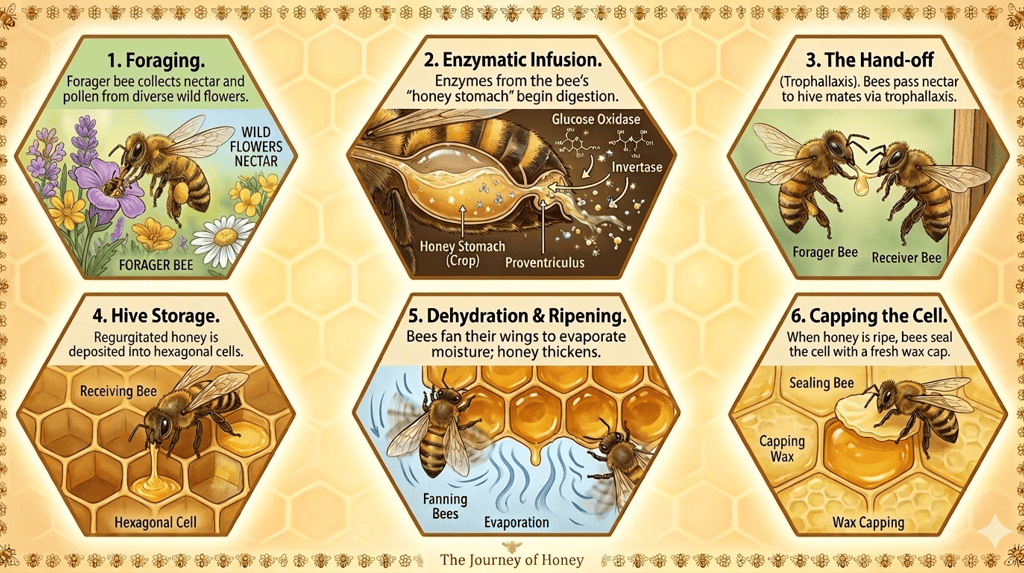
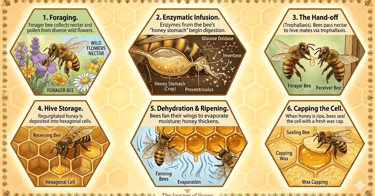
1. Nectar Collection
Foraging bees fly from the hive to locate flowers with high sugar content. They use their long, straw-like tongues (proboscises) to suck up nectar, storing it in a specialised secondary stomach called the Crop or "honey stomach." This organ is separate from their digestive tract and is used purely for transport.
2. Enzymatic Infusion
The transformation begins the moment the nectar enters the bee's crop. Worker bees secrete an enzyme called glucose oxidase from their hypopharyngeal glands. This enzyme mixes with the nectar, initiating a chemical reaction that will eventually help preserve the honey.
3. The Hand-off (Trophallaxis)
Once the forager returns to the hive, she regurgitates the nectar and passes it to "house bees." These bees pass the liquid from mouth-to-mouth in a process called trophallaxis. This further mixes the nectar with more enzymes, breaking down complex sugars (sucrose) into simple sugars (glucose and fructose).
4. Hive Storage
The bees deposit the processed, watery nectar into the hexagonal wax cells of the honeycomb. At this stage, the substance is still very high in water content (around 70–80%) and would ferment if left as is.
5. Dehydration and Ripening
To thicken the honey, the bees engage in a communal cooling and drying effort. They gather around the cells and flap their wings rapidly, creating a constant draft that evaporates the excess moisture. They continue this until the water content drops below 18%.
6. Capping the Cell
Once the honey has reached the perfect thickness and chemical balance, the bees seal the cell with a fresh layer of white beeswax. This "cap" acts as an airtight seal, preventing the honey from absorbing moisture from the air and allowing it to be stored indefinitely.
The Chemical Formula
The preservation of honey is largely due to the specific oxidation reaction mentioned earlier. The biochemical process of ripening can be summarised by the following formula:
C₆H₁₂O₆ + H₂O + O₂ —(Glucose Oxidase)→ C₆H₁₂O₇ + H₂O₂
C₆H₁₂O₆ (Glucose): The natural sugars found in the nectar.
H₂O & O₂: Water and Oxygen, which are necessary for the reaction to occur.
C₆H₁₂O₇ (Gluconic Acid): This is the "acidifier." It lowers the pH of the honey to a level where bacteria cannot survive.
H₂O₂ (Hydrogen Peroxide): This is the "protector." It provides the natural antibacterial properties that make honey a medicinal powerhouse.
In this reaction, Glucose (C₆H₁₂O₆) is converted into Gluconic Acid (C₆H₁₂O₇) and Hydrogen Peroxide (H₂O₂) is produced as a byproduct, providing the honey with its natural antibacterial properties.
The Apiary Glossary: Understanding Bee Anatomy and Why Honeybees Have Two Stomachs
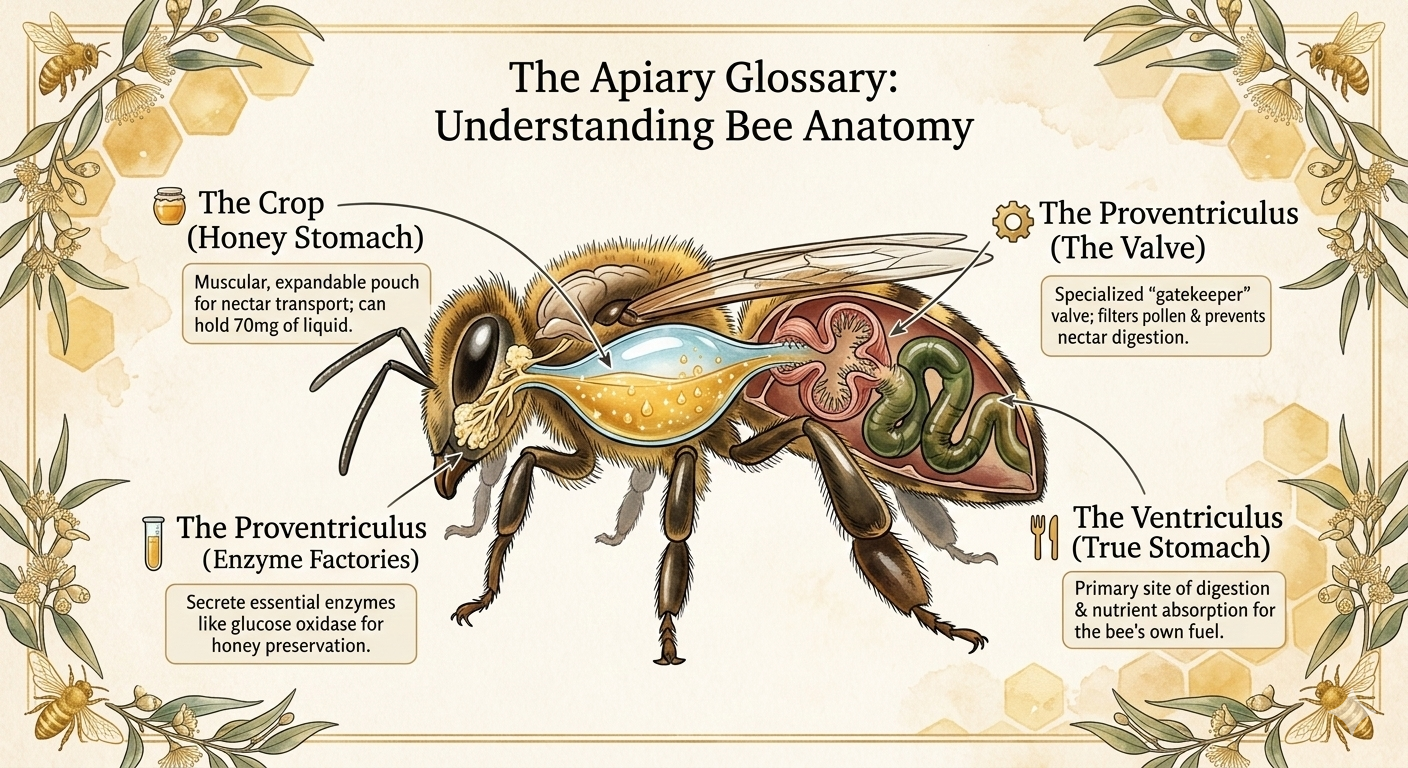
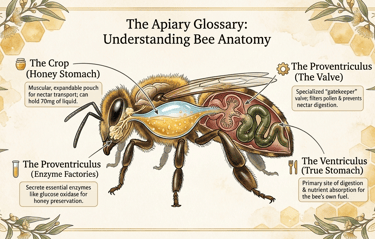
The Crop (Honey Stomach): Nature’s Backpack: Notice in the diagram how the crop is a large, muscular forward pouch. This is where nectar is held after a bee visits a flower. It is not used for nutrition but as an expandable storage tank, often holding up to 70mg of liquid, nearly the bee's own body weight.
The Proventriculus (The Valve): The Essential Gatekeeper: Observe the valve connecting the crop to the ventriculus. This is the crucial separation point. When a forager is flying, the proventriculus remains locked, ensuring that none of the gathered nectar leaks into the bee’s digestive system, preventing contamination and preserving the nectar's purity.
The Ventriculus (True Stomach): The Fuel Tank Positioned after the proventriculus, this is where the bee digests its own food. If the bee needs energy to complete her flight, she passes a tiny, regulated amount of nectar through the valve to fuel herself, while keeping the rest stored for the hive. Once nectar enters here, it cannot be returned to the Crop.
Hypopharyngeal Glands (Enzyme Factories) As the nectar sits in the crop, it is not just stored; it is enriched. Located in the head of the worker bee, these glands secrete the necessary enzymes, such as glucose oxidase, that trigger the preservation reaction by creating gluconic acid and hydrogen peroxide.
Navigating the Hive’s Chemistry Set
To truly understand how bees create such a pure and bioactive food, we must understand their internal specialised systems. This anatomical diagram illustrates the core components of the "honey kitchen," showing how nectar is collected, processed, and preserved without ever being digested by the bee.
[Diagram of Bee Internal Anatomy: Crop, Proventriculus, Ventriculus]

Melli Magic Honey™
Embrace the essence of 100% pure, natural, raw, Australian honey!
+61-411234759
Melli Magic Honey™© 2025. All rights reserved.
Premium Australian Honey
Subscribe to our newsletter!
ABN: 65366959676
149 The Grand Parade, Monterey, NSW, 2217