✅ "Pharmacy-trusted since 2013, now delivering Australia's rarest raw honeys direct to your door."

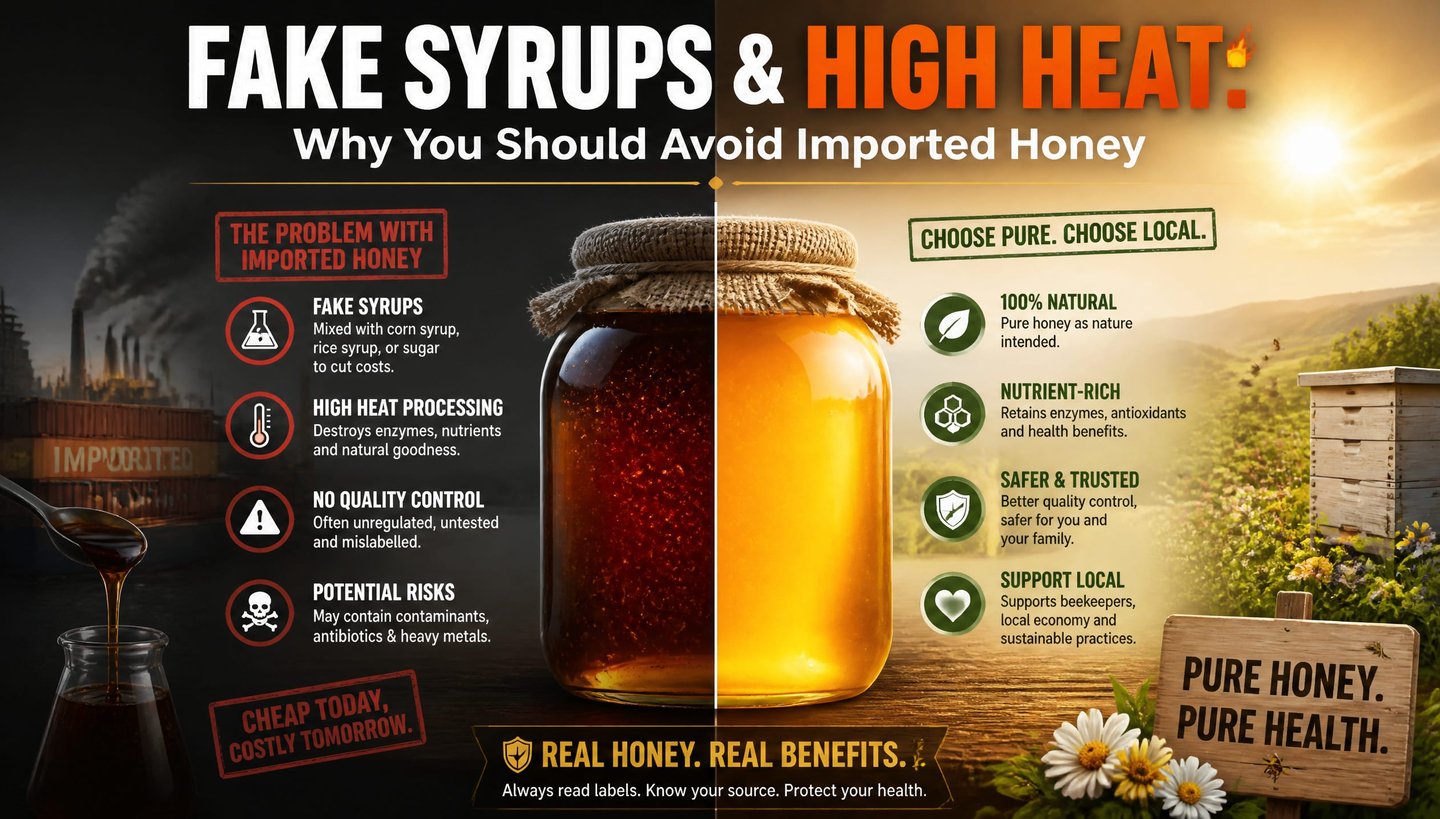
Fake Syrups & High Heat: Why You Should Avoid Imported Honey
Unpacking the bioactive differences between imported and the natural benefits of pure, raw Australian honeys.
The Truth Inside the Jar: Why Pure Raw Australian Honey Beats Imported Honey!
When you pull a jar of honey off a fruit shop or supermarket shelf, you expect it to be pure. But the reality is that imported commercial honey undergoes a gauntlet of heavy processing, blending, and heat treatments before it reaches your taste buds.
Here is why true, raw Australian honey is in a league of its own:

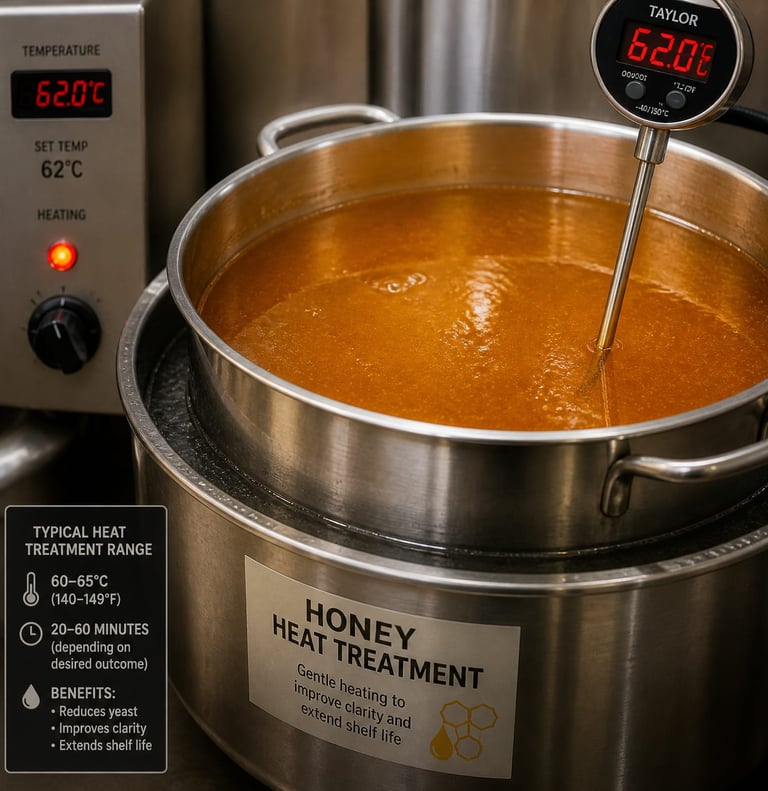
The Heat Treatment Trap: Why Imported Honey is Biologically "Dead"
The Biosecurity Mandate: To clear Australian borders, imported honey is aggressively heated (often 60°C+) to destroy bacterial spores. Eliminating resilient American Foulbrood (AFB) spores requires extreme measures.The standard procedure for processing honey involves heating it to 121°C under a pressure of 103 kPa for a minimum of three minutes. This thorough autoclaving process is essential to meet biosecurity requirements. As a result, commercial imports often lack their natural enzymes, unlike our Australian cold-extracted raw honey, which retains these beneficial components.
Enzyme Destruction: High heat destroys vital enzymes, specifically glucose oxidase.
Loss of Bioactivity: Without these enzymes, honey loses its natural hydrogen peroxide production, transforming a therapeutic product into an inactive sugar syrup.
The Syrup Deception
Honey is notoriously one of the most counterfeited foods on the planet. Many imported "honeys" are actually bulk blends stretched with cheap rice, corn, or cassava syrups. While standard border testing catches some of this, sophisticated fake sugars easily slip through the cracks. Catching these fakes requires advanced laboratory fingerprinting that is too expensive to run on every batch. When you buy cheap imported honey, there is a high chance you are paying for watered-down syrup.
The Loss of Identity
To maintain imported honey in a clear, liquid state on store shelves for an extended period, it undergoes ultrafiltration. This intense mechanical process removes all natural pollen and microscopic debris. As a result, the honey loses its nutritional complexity and its botanical identity. You can no longer determine the types of flowers it came from or even the country of its true origin.
Australia's Biosecurity Rules for Imported Honey
To protect the local agricultural sector from devastating bee diseases—most notably American Foulbrood (AFB), European Foulbrood, and exotic viruses—the Department of Agriculture, Fisheries and Forestry (DAFF) enforces strict import conditions through the BICON (Biosecurity Import Conditions) system.
For commercial honey to enter Australia, it generally must fulfil one of two primary pathways:
Pathway 1: Mandatory Treatment (Heat or Irradiation): If the honey comes from a country that cannot definitively prove it is free from specific bee diseases, it must undergo intense commercial processing to neutralise bacterial spores before entering Australia. This is usually achieved through high-heat pasteurisation or gamma irradiation. As established earlier, this level of heat (e.g., 121°C under pressure for AFB spores) destroys the natural enzymes and bioactivity of the honey.
Pathway 2: Strict Government Certification: If the honey is not subjected to these extreme treatments, it must come from an approved country or zone officially recognised by Australia as free from these specific diseases. In this case, the honey must be accompanied by an official, government-issued health certificate from the exporting country that verifies its origin, health status, and compliance with testing requirements.
Overseas Lab Testing and Border Checks
When relying on certificates rather than heat treatment, the documentation requirements are extensive. Importers must supply:
A BICON import permit.
An official Certificate of Origin.
A government health certificate verifying the honey was extracted and packed under specific sanitary conditions.
Upon arrival, DAFF’s Imported Food Inspection Scheme (IFIS) will randomly refer a percentage (usually around 5%) of honey consignments for analytical testing at the border. This testing primarily checks for public health standards, moisture content, and basic adulteration (such as the standard C4 carbon isotope test, which looks for cane or corn syrup)
The Reality of Fraud: Can Certificates be Falsified?
Yes. Honey is widely recognised as one of the top three most adulterated and counterfeited foods in the world. Despite strict Australian border checks, the global supply chain is heavily compromised by a practice known as "honey laundering."
Here is how fraudulent honey and falsified certificates enter legitimate markets:
Falsified Certificates of Origin (Transhipment): The most common form of honey fraud involves disguising the true origin of the product. Cheap, heavily adulterated honey (often mass-produced in countries with known disease or quality issues) is shipped to a secondary, "safe" country. In that middle-man country, the honey is relabeled, and new, fraudulent Certificates of Origin are generated before it is exported to countries like Australia.
Beating the Border Lab Tests: The standard C4 isotope tests used at most borders are outdated. Fraudulent manufacturers use C3 sugars (such as rice syrup, beet syrup, or cassava syrup) which chemically mimic the sugar profile of real honey. An imported batch can carry an overseas lab certificate declaring it "100% pure," easily pass an Australian C4 border test, and still be composed of 50% rice syrup.
Corrupt Overseas Certification: In some regions, official government or laboratory certificates can simply be purchased or falsified by export brokers. Unless the honey is subjected to Nuclear Magnetic Resonance (NMR) spectroscopy—an expensive, advanced laboratory fingerprinting method that maps the exact botanical and geographical origin of the honey—a standard paper certificate cannot definitively prove the honey is pure or safe.
Because NMR testing is highly expensive and not federally mandated for every single imported batch at the Australian border, shipments backed by falsified or manipulated overseas certificates can and do slip through the cracks.
To avoid adulterated imported honey, buy Melli Magic pure, raw, cold-extracted Australian honey.
The Great Australian Honey Trap: Uncovering the Fake Syrup Pipeline


Sweet Deception Down Under: The "Victoria Honey" Illusion
In 2014, Australia’s consumer watchdog (the ACCC) penalised local supplier Basfoods for passing off a deceptive product as "Victoria Honey." Instead of authentic honey from bees, the spread was a heavily processed sugar syrup imported from Turkey.
This incident highlights a well-documented scheme in international food fraud. Often, inexpensive synthetic sweeteners—frequently manufactured in China—are diverted to intermediary nations like Turkey. Once there, the artificial syrups are mixed, repackaged, and funnelled into the global market entirely disguised as 100% pure honey.
The "Hellenization" Pipeline
While Europe as a whole is battling this issue, Greece represents a unique pressure point. Greece boasts a rich, historic beekeeping culture, but domestic supply simply cannot keep up with consumer demand, forcing the country to rely on imports.
Data from Greece’s Independent Public Revenue Authority reveals that between 2020 and 2023, the country imported nearly 2 million kilograms of honey from China, worth over €2.6 million.
The crime, however, goes beyond cheap imports—it is the deliberate deception of passing this synthetic syrup off as a premium local product. Anastasios Pontikis, head of the Federation of Beekeeping Associations of Greece, has detailed exactly how this scheme operates:
Stripping the DNA: Fraudsters run the imported Chinese syrups through advanced ultra-filtration systems. This process strips away all the natural pollen grains.
Erasing the Paper Trail: Because pollen acts as a geographical and botanical fingerprint, removing it makes it scientifically impossible to trace the syrup's true origin.
The "Hellenization" Finish: The untraceable syrup is shipped to Greece, lightly blended with genuine local honey for flavour, and then illegally relabeled and sold at a premium as 100% pure Greek honey.
In response to these EU-wide findings, the Hellenic Food Authority (EFET) has actively investigated and identified several domestic operators who were complicit in importing, blending, and mislabeling these fraudulent syrups.
The 2023 "From the Hives" Exposé
The most definitive proof of this illicit trade was published in March 2023. A joint task force featuring the European Anti-Fraud Office (OLAF) and the Joint Research Centre (JRC) launched a sweeping border-check operation called From the Hives. Their findings were staggering:
Widespread Adulteration: Nearly half (46%) of all honey entering the EU was flagged as fraudulent, heavily cut with cheap wheat, rice, or sugar beet syrups.
China as the Epicentre: Of the shipments originating from China, an overwhelming 74% were identified as suspicious.
The Profit Motive: With authentic honey costing around €2.32 per kilogram to produce and fake rice syrups costing a mere €0.40 per kilogram, the financial incentive for fraudsters is enormous.
The Raw Australian Advantage
True, authentic Australian raw honey is extracted exactly as the bees made it. Because it isn't subjected to extreme heat or ultra-filtration, it retains all of its natural bioactivity, complex enzymes, and pure pollen content. Buying local also means you experience the true, unaltered flavours of native Australian flora—from the rich, bioactive power of Jarrah and Tea Tree to the delicate, floral sweetness of indigenous Macadamia blossoms.
Don't settle for heavily processed sugar syrups. Choose raw, local, and authentically Australian.

Melli Magic Honey®
+61-411234759
Melli Magic Honey® © 2026. All rights reserved.
ABN: 65366959676
149 The Grand Parade, Monterey, NSW, 2217