✅ "Pharmacy-trusted since 2013, now delivering Australia's rarest raw honeys direct to your door."

Is Your Honey Real? Fake Honey vs. Real Honey: A 2026 Guide to Honey Purity!
Discover the truth about fake honey and why choosing a pure, raw Australian Honey, like Melli Magic Honey, matters in a market flooded with fakes."
The Growing Challenges of Honey Adulteration: The Definitive 2026 Report on Honey Fraud and Purity!
Why Honey Ranks in the Top 3 for Global Food Fraud
Honey consistently ranks among the most adulterated food products in the world, including Australia, trailing only milk and olive oil in the frequency of impurities. This widespread issue is fueled by soaring global demand and the premium price commanded by pure honey. "Driven by profit, the food fraud industry has traditionally created fake honey by diluting it with inexpensive corn or cane syrups. However, the threat to honey purity has evolved. As we navigate 2026, the global market faces a much more sophisticated challenge: advanced, lab-engineered syrups specifically designed to bypass standard authenticity tests."
The New "Designer" C3 Industrial Syrups
Food fraudsters have evolved, moving away from basic sugars and developing "designer" C3 syrups made from rice, wheat, and beet. The major issue? These industrial syrups are specifically engineered to mimic the natural chemical profile of pure nectar. They blend seamlessly into the jar, allowing fake or heavily diluted honey to slip past outdated regulatory tests easily.
Why Honey Purity Matters
These deceptive practices do more than lower the quality of the product—they strip away the essential nutritional benefits of raw honey. Adulterated honey lacks the complex enzymes, antioxidants, and pollen that consumers expect from a natural superfood.
Supporting Ethical Beekeeping
Honey fraud doesn't just mislead shoppers; it creates an unfair market for local beekeepers who labour to produce genuine, high-quality honey. When cheap, synthetic alternatives flood the market, it undermines the sustainability of the beekeeping industry and the health of our global ecosystem.
The New Fake Honey in 2026: How "Designer Syrups" are Tricking the System
For decades, spotting fake honey in a laboratory was relatively easy. Food standard agencies used a basic "Carbon Isotope Test" to detect the presence of C4 sugars—the type of sugar found in cheap corn syrup and sugar cane. If a batch of honey spiked on the C4 test, it was instantly flagged as fake.
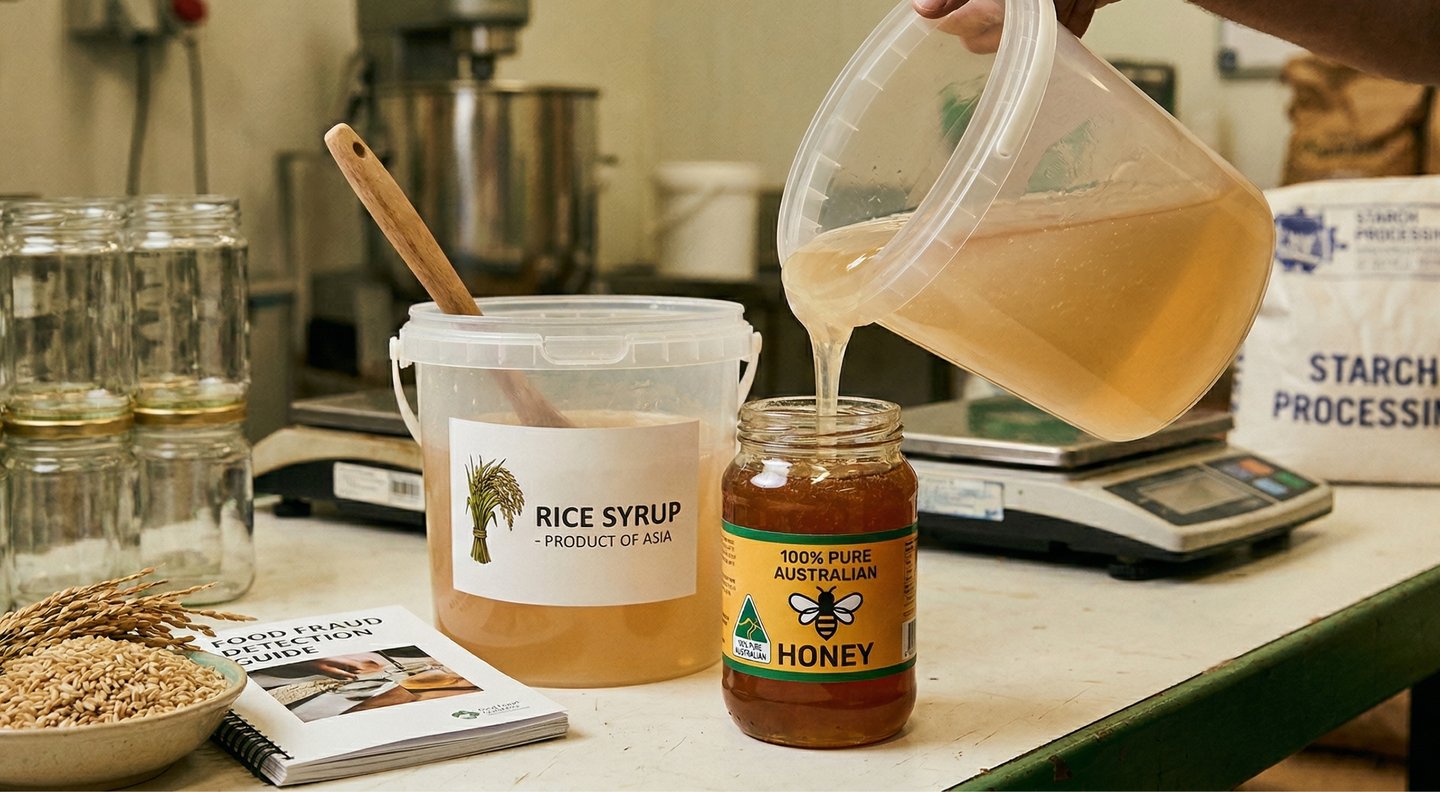
But the counterfeiters adapted. Today, the global market is battling a wave of chemically engineered "designer syrups" specifically manufactured to bypass traditional testing. Here is exactly how these synthetic fakes mimic the real thing:
The C3 Sugar Loophole: Instead of corn or cane sugar, modern fraudsters use syrups derived from rice, wheat, and sugar beets. Because these plants are "C3" plants, their carbon footprint perfectly matches the nectar that bees collect from flowers, rendering the old isotope tests completely useless.
Synthetic Enzyme Spiking: Pure honey naturally contains specific enzymes (like diastase and invertase) created by the bees themselves. To fool laboratory tests looking for these markers, illicit factories now artificially inject lab-made enzymes into their synthetic syrups.
Ultrafiltration (Pollen Washing): Real honey contains trace amounts of local pollen, which acts as a geographical fingerprint. Counterfeiters heavily heat and ultra-filter their fake honey to strip out all original pollen, making it impossible to trace the syrup back to its cheap, overseas origins.
Engineered Ratios: The perfect stickiness, thickness, and colour of genuine honey come from a delicate natural balance of fructose and glucose. Designer syrups are now chemically reverse-engineered to perfectly match this exact ratio, mimicking the visual flow and texture of the real deal.
How do these Syrups Bypass Honey Lab Tests in 2026?
"Modern honey adulteration in 2026 relies on sophisticated C3 plant syrups—primarily Rice, Wheat, and Beet—along with the emerging threat of Cassava (Manioc) syrup."
"Beyond Syrups: How Synthetic Adulterants Mask the Chemistry of Honey Fraud"
While most consumers worry about cheap sugar, modern honey fraud involves "hidden" synthetic adulterants designed to manipulate the honey's chemical profile. In 2026, detecting these requires advanced AI-enhanced FTIR and Chemometrics, as traditional tests simply cannot identify them.
Exogenous Enzymes: The "Speed-Up" Chemicals
In nature, bees use enzymes to slowly convert nectar into honey. Fraudulent producers add laboratory-made enzymes to sugar water to mimic this process instantly:
Invertase: Used to break down sucrose into fructose and glucose to match a natural sugar profile.
Beta-fructofuranosidase: Specifically used to mask the addition of cane or beet sugar.
Amylase: Added to digest starches in cheap syrups (like corn or wheat) so they don't show up in standard laboratory starch tests.
Synthetic Amino Acids: Faking the Fingerprint
Honey has a natural amino acid profile that acts as a biological fingerprint. Fraudsters now "spike" low-quality honey with synthetic Proline to bypass purity thresholds.
The AI Solution: Our Chemometric analysis doesn't just look for Proline; it looks at the ratio of all amino acids. If the balance is off, the AI flags it as a synthetic additive.
Artificial Colourants and "Designer" Aromas
When honey is heavily diluted with clear rice or cassava syrup, it loses its natural amber hue and floral aroma.
Caramel Colour (E150): Used to darken pale syrups to mimic premium Forest or Manuka honey.
Synthetic Pollen: High-tech frauds now include adding "pollen-like" particulates to filtered, fake syrup to trick microscopic analysis.
Antibiotics
While not a "filler," antibiotics are adulterants that compromise food safety:
Chloramphenicol: A powerful antibiotic occasionally found in honey from poorly managed regions.
"From Water Dilution to Melted Candy: The Low-Tech Side of Honey Fraud"
Beyond the industrial syrups we've discussed, there are several "low-tech" but common substitutes used to stretch honey. These are often used by smaller-scale fraudsters or in markets where high-tech "designer syrups" aren't as available.
Here’s a detailed breakdown of these substitutes and the specific issues they create for consumers and the testing standards set for 2026.
Water Dilution (The "Volume Booster")
This is the simplest form of adulteration. By adding water, a producer can turn 100kg of pure honey into 120kg.
The Problem: Honey is naturally low in moisture (usually under 18%). When you add water, you raise the water activity, which allows yeast and bacteria to grow.
The Result: The honey will eventually ferment, creating a sour smell and causing the jar to "pop" or leak due to gas buildup. It also destroys the medicinal "Total Activity" (TA) levels you've focused on since 2013.
"Melted" Candies and Confectionery Waste
In some regions, discarded or "off-spec" hard candies and industrial sugar scraps are melted down into a thick, clear liquid.
The Problem: These contain artificial flavours, dyes, and preservatives (like Citric Acid or Potassium Sorbate) that are never found in a beehive.
The Result: While it might look like honey, it lacks the complex enzymes and antioxidants. AI-enhanced FTIR easily spots these because the "molecular peaks" for synthetic dyes and preservatives stand out like a sore thumb against a natural floral background.
Jaggery or Molasses (Dark Honey "Fakes")
To mimic high-value dark honeys (like some of the Australian forest honeys you produced before the 2019 bushfires), fraudsters sometimes use dark unrefined sugars.
The Problem: Jaggery and molasses have a very high mineral content and a "burnt" sugar chemical profile.
The Result: They significantly alter the electrical conductivity of the honey. Lab tests for Chemometrics flag this immediately because the mineral "fingerprint" doesn't match the soil profile of the Australian flora it’s supposed to come from.
C4 Sugars: Corn and Cane Syrup
While we focused on C3 syrups (Rice/Wheat), C4 sugars are the "old school" substitutes.
The Problem: These are the easiest to detect, but still widely used because they are incredibly cheap.
The Result: They are caught by the AOAC 998.12 (SCIRA) test. However, fraudsters now use them in smaller amounts (under 5%) mixed with C3 syrups to try to stay under the radar of older lab equipment.
"2026 Lab-Testing Update: Detecting Novel Syrups and 'Ghost' Sugars"
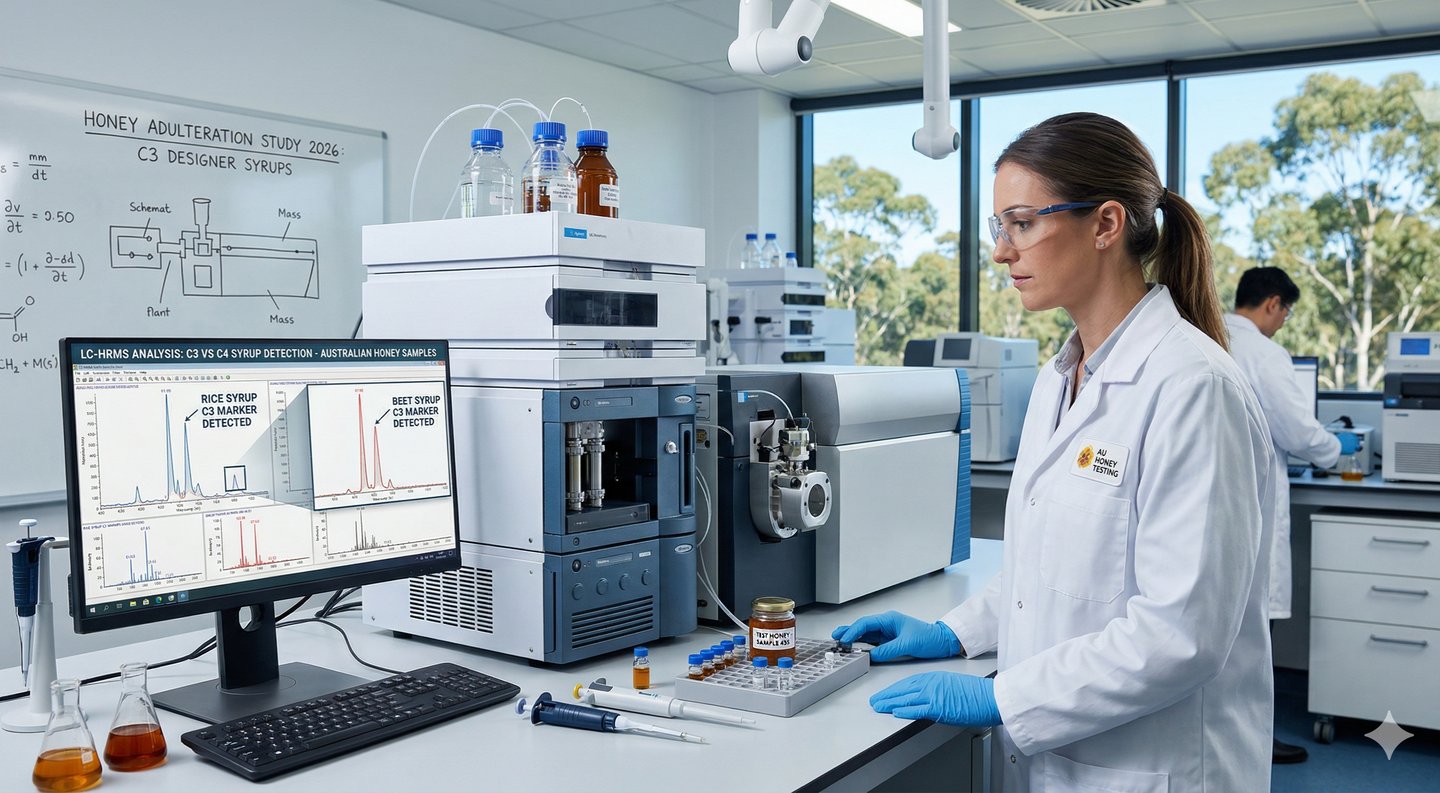
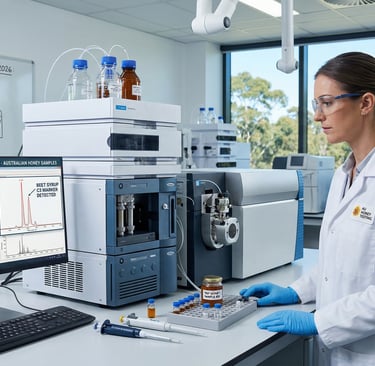
Leading international laboratories are developing new methods to detect previously undetectable counterfeits. Using advanced technology known as LC-HRMS (Liquid Chromatography-High Resolution Mass Spectrometry), scientists can now scan a jar of honey for specific molecular "fingerprints." If a product contains even a small amount of these industrial designer syrups, the lab equipment will detect a molecular peak that does not occur in pure, raw nature.
The Power of LC-HRMS in 2026
In 2026, LC-HRMS (Liquid Chromatography-High Resolution Mass Spectrometry) has become the ultimate "truth serum" for honey. Here is why it is the perfect partner for the AI and FTIR methods we will discuss below.
Mass Accuracy to the 4th Decimal: Traditional machines might see a sugar molecule and think it's "Glucose." LC-HRMS looks at the exact weight of that molecule to four decimal places. It can tell the difference between a glucose molecule from an Eucalyptus blossom and one from a chemically processed Rice or Cassava syrup.
Scanning for 500+ Adulterants at Once: Unlike old tests that look for one specific syrup, LC-HRMS does a "Non-Targeted Scan." It looks at every single compound in your honey. If a fraudster uses a "novel" syrup that hasn't even been named yet, the machine will flag it as an "Unknown Molecular Peak" that shouldn't be there.
The AI Connection: In 2026, the massive data generated by LC-HRMS is fed directly into Chemometric AI models. This allows labs to not only say "this is fake," but to pinpoint exactly which factory produced the syrup based on its chemical impurities.
"Understanding AI and FTIR: The 2026 Standard for Honey Verification"
Think of FTIR as the "digital eye" and AI as the "super-intelligent brain" working together to verify your honey. When you've been supplying pharmacies since 2013, you know that physical consistency isn't enough; you need molecular proof.
Here is a breakdown of how these two 2026-standard technologies actually work:
FTIR (Fourier-Transform Infrared Spectroscopy)
FTIR is a scanning technology that uses infrared light to "read" the molecular bonds in a substance.
The Process: A tiny sample of Melli Magic Honey is placed on a crystal sensor. We shine an infrared beam through it.
The "Vibration": Every molecule (glucose, fructose, antioxidants, pollen) vibrates at a specific frequency when hit by that light.
The Result: The machine produces a Molecular Fingerprint (a graph of peaks and valleys). Pure honey has a very specific "landscape," while rice or cassava syrups have different "peaks" that shouldn't be there.
AI & Chemometrics (The Brain)
While the FTIR creates the graph, the AI is what interprets it with 99.9% accuracy.
The Database: The AI is trained on thousands of global honey samples (Manuka, Eucalyptus, Wildflower) and thousands of known "fake" syrups.
Pattern Recognition: Humans might miss a tiny 1% spike in a "Ghost Sugar," but the AI identifies it instantly. It looks for Chemometric markers—mathematical relationships between different compounds.
The Verification: The AI confirms two things:
Purity: Is there anything in here that didn't come from a bee?
Origin: Does this chemical profile match the Australian flora from your specific harvest region?
Why They Must Work Together
FTIR alone is just a picture; AI is the expert who knows exactly what that picture should look like. In 2026, this is called "Non-Targeted Screening." Instead of looking for one specific poison or syrup, the AI-FTIR method looks for anything that looks "wrong" compared to a pure hive sample. This is why it catches the "New Kid on the Block" Cassava syrup, even when traditional C4 sugar tests fail.
The Cat-and-Mouse Game: Why Honey Purity is Like Cybersecurity
Understanding global honey adulteration is a lot like looking at the cybersecurity industry. Just as computer experts must constantly update their antivirus software to block the latest internet threats, hackers are already working in the background to write new malware that bypasses those exact updates.
The commercial honey market is locked in this exact same, relentless loop:
The Defence: Food scientists and regulatory bodies develop a strict new testing method to catch counterfeit honey, such as the Carbon Isotope test.
The Hack: Unscrupulous producers immediately analyse the new test, find the loophole, and engineer a new way to disguise their fakes—like switching from C4 corn syrup to C3 rice syrup so the test registers a "pass."
The Patch: Laboratories respond by testing for natural bee enzymes to prove the honey came from a hive.
The Next Hack: The fraudsters adapt again, legally purchasing synthetic, lab-made enzymes to spike their vats of fake syrup, perfectly mimicking a natural chemical profile.
Every time a new detection method is rolled out, the fraudsters innovate to beat it. As we navigate 2026, the methods used to disguise counterfeit honey are more sophisticated, well-funded, and harder to detect than ever before.
The Only Foolproof Antivirus. How do you protect your family when the "threats" are constantly changing and the supermarket and fruit shops' testing standards are always one step behind?
You step off the playing field entirely.
The only guarantee of honey purity is extreme transparency. By choosing Melli Magic Honey, you are bypassing the compromised commercial supply chains where this cat-and-mouse game is played. When you buy 100% pure, raw Australian honey directly from dedicated beekeepers, you never have to worry about outsmarting the latest food fraud—you just get to enjoy nature's perfect sweetener.
Australia's 5% Honey Import Rules: A System Under Pressure
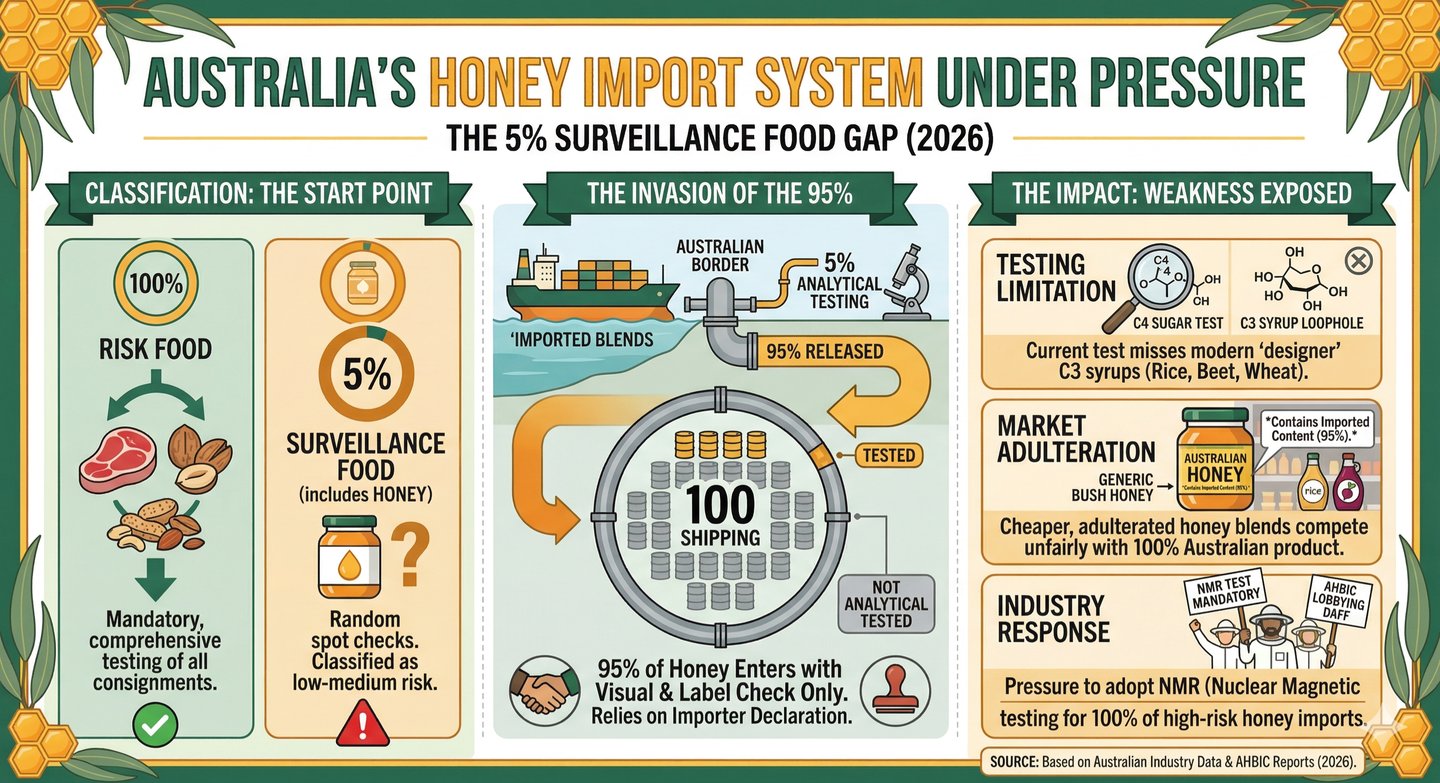
While the science of detecting food fraud is advancing rapidly, Australia's border regulations are struggling to keep pace. The Department of Agriculture, Fisheries and Forestry (DAFF) currently classifies imported honey as a "surveillance food."
What does that mean for the supermarket shelves? It means a mere 5% of honey consignments entering the country are actually pulled aside for analytical testing. To make matters worse, the official baseline test required by the government is the outdated C4 sugar test (AOAC 998.12). This test is completely blind to the new wave of C3 designer syrups.
Recognising this massive loophole, the Australian Honey Bee Industry Council (AHBIC) has been fiercely lobbying to mandate NMR (Nuclear Magnetic Resonance) testing for all imports. Until then, the system relies on a reactive approach: if an importer's batch fails the 5% spot check, DAFF will increase its specific inspection rate to 100% until they can prove consistent compliance. But for the 95% of untested imports, it is an open door.


Australia's Import Rules: A System Under Pressure
While the science of detecting food fraud is advancing rapidly, Australia's border regulations are struggling to keep pace. The Department of Agriculture, Fisheries and Forestry (DAFF) currently classifies imported honey as a "surveillance food."
What does that mean for the supermarket shelves? It means a mere 5% of honey consignments entering the country are actually pulled aside for analytical testing. To make matters more concerning, the official baseline test required by the government is the outdated C4 sugar test (AOAC 998.12). This test is completely blind to the new wave of C3 designer syrups.
Recognizing this massive loophole, the Australian Honey Bee Industry Council (AHBIC) has been fiercely lobbying to mandate NMR (Nuclear Magnetic Resonance) testing for all imports. Until then, the system relies on a reactive approach: if an importer's batch happens to fail that 5% spot check, DAFF will increase their specific inspection rate to 100% until they can prove consistent compliance. But for the 95% of untested imports, it is an open door.
Honey Facts
What is adulterated honey?
Adulterated honey is mixed with cheaper substances like sugar syrup.
How to spot fake honey?
Fake honey often lacks natural aroma and crystallizes differently than pure honey.
Why is pure honey better?
Pure honey contains natural enzymes and antioxidants that support health and taste.
Can I test honey at home?
Yes, simple tests like water solubility can indicate purity.
Is all honey safe to eat?
Not always; adulterated honey may contain harmful additives.

I never knew how common fake honey was until I read this page—eye-opening!
Anna B.


This info helped me choose real honey at the market with confidence.
Mark T.


★★★★★
★★★★★
Melli Magic Honey®
+61-411234759
Melli Magic Honey® © 2026. All rights reserved.
ABN: 65366959676
149 The Grand Parade, Monterey, NSW, 2217