✅ "Pharmacy-trusted since 2013, now delivering Australia's rarest raw honeys direct to your door."

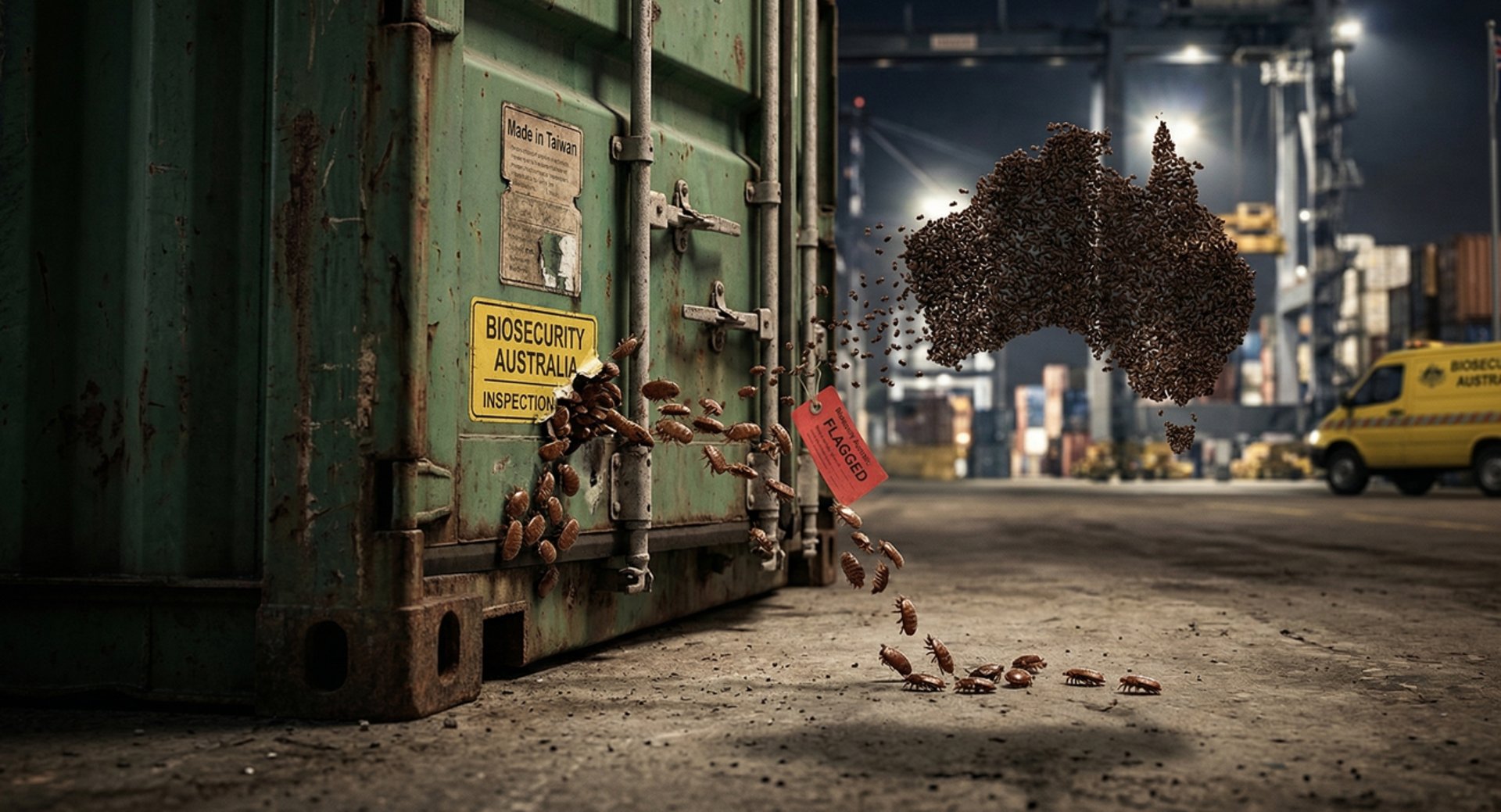
Varroa Mite: Operation Decker Report & Biosecurity Failure
"From pharmacy shelves in 2013 to the 2026 Biosecurity Frontline: Brad Burns reports on Australia’s latest Varroa mite crisis news."
AHBIC Slams Federal Investigation Over Inconclusive Varroa Findings: March 17 2026
Nearly four years after the initial discovery of the Varroa mite, the Australian Honey Bee Industry Council (AHBIC) has slammed a federal investigation for failing to pinpoint how the pest breached our borders. The final report from Operation Decker, released on March 17, 2026, leaves the industry in the dark, failing to identify the entry point, the timing of the breach, or the specific circumstances of the incursion.
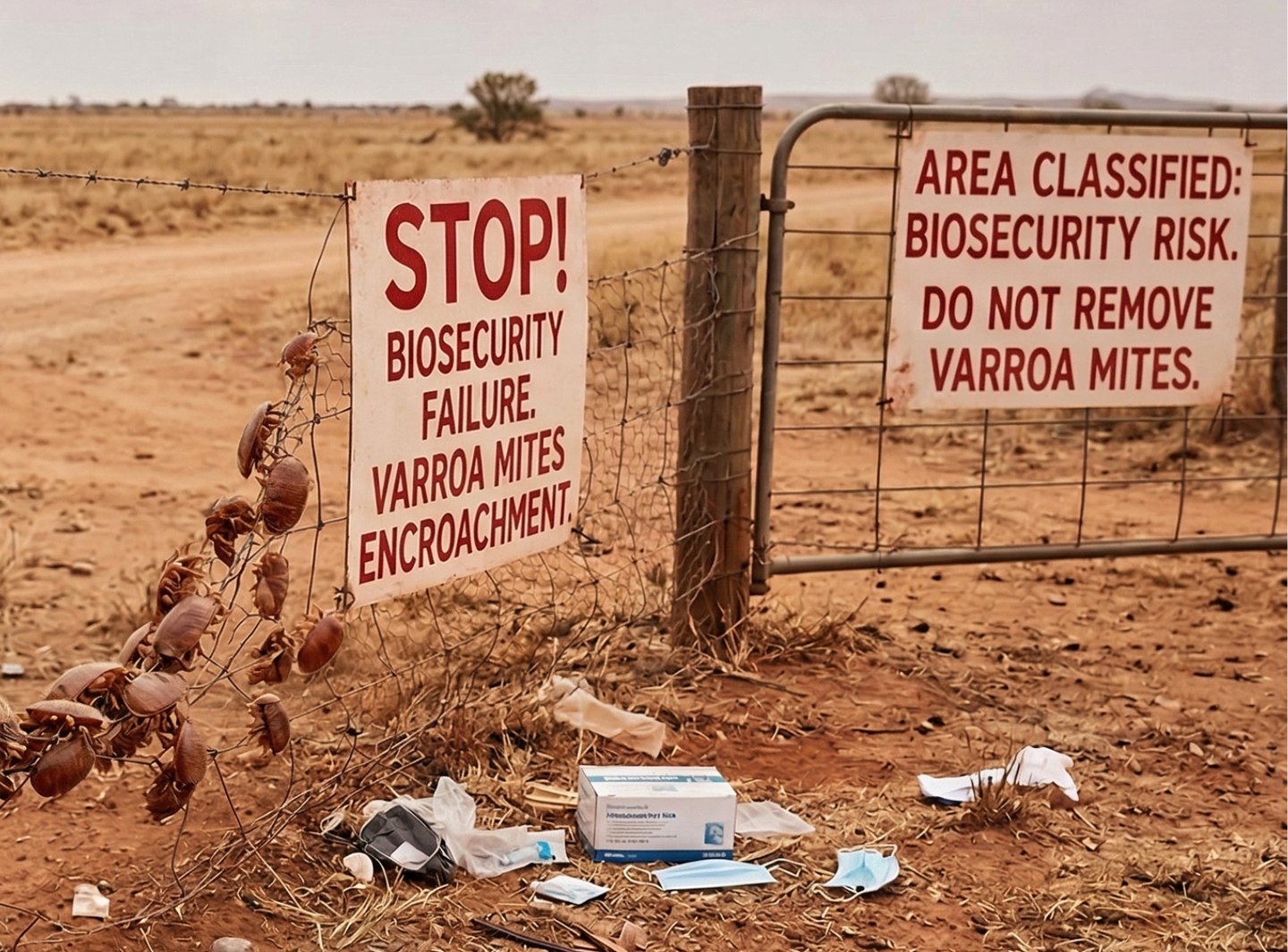
Genetic Devastation: Varroa and the L925I "Super Mite", What's Next?
Key Points of Contention
The AHBIC CEO, Danny Le Feuvre, highlighted a growing sense of frustration among beekeepers, noting that "inconclusive" findings offer zero protection against the next wave of threats knocking on Australia's borders.
No Smoking Gun: The report found no direct evidence of illegal importation or smuggling.
Forensic Gaps: Physical and digital evidence failed to provide a clear timeline.
The Result: The arrival of one of the world’s most devastating agricultural pests in Australia remains a mystery, and now we have the "Super Mite", L925I mutation.
Mystery Varroa Mite Origin Leaves Australian Honey Industry Stung
Australia’s beekeeping sector is demanding government accountability following a final report that failed to identify the source of the 2022 Varroa mite incursion. Despite the honey bee industry contributing $264 million in hive products and a staggering $4.6 billion in annual pollination services, the mystery of how the pest entered the country remains unsolved.
For decades, Australia stood as the world’s final stronghold against the honeybee’s most formidable enemy, the Varroa destructor. While our biosecurity teams had successfully monitored and contained minor "breaches" via cargo ships as early as 2018, the status of the Australian hive changed forever on June 22, 2022. During routine surveillance of sentinel hives at the Port of Newcastle, NSW, the first mainland colony of Varroa mite was confirmed. This wasn’t merely just a discovery; it was the onset of the largest biosecurity siege in our nation’s history, fundamentally shifting the landscape for every Australian beekeeper and honey producer.
While Australia once relied on its vast oceans to act as a natural fortress, that era of passive protection is now over. Modern trade routes and hardy invasive species have pierced our defences, revealing a system in decline. The 2022 Newcastle detection—and Operation Decker's failure to identify its source- is evidence of a deepening biosecurity crisis. "This lack of transparency poses a threat not only to honey production but also to the $4.6 billion pollination sector, which is indispensable to Australian agriculture."
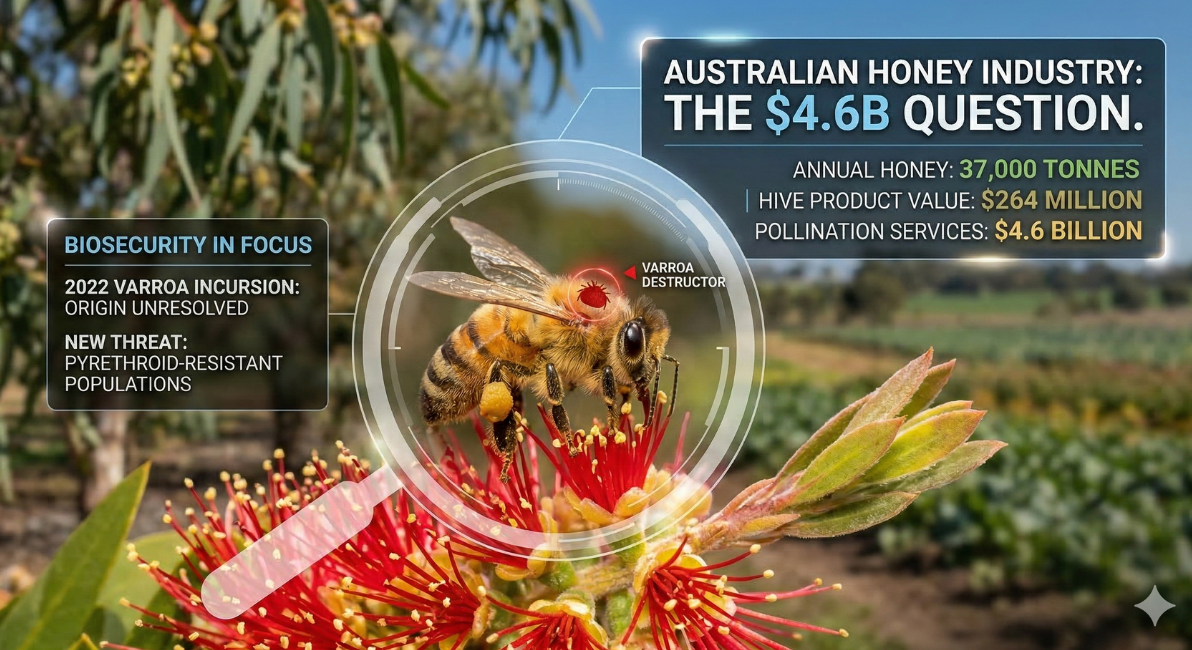
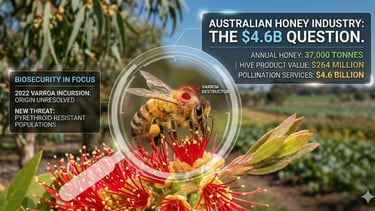
The Biosecurity Comparison: Why 2018 Succeeded, and 2022 Failed
The current disappointment among Australian beekeepers isn't just about the presence of the mite; it’s about the visible breakdown of a protection system that once felt impenetrable. For years, Australia’s National Bee Pest Surveillance Program (NBPSP) was the envy of the global agricultural community, successfully intercepting exotic threats before they could ever establish a foothold.
The 2018 Interception: A Model of Success
The most notable victory occurred in June 2018 at the Port of Melbourne. Biosecurity officers intercepted a swarm of bees carrying Varroa destructor tucked inside a cargo ship arriving from Texas, USA.
The System at Work: Because this incursion was detected "on the water" through rigorous port surveillance, the threat was immediately neutralised.
Swift Action: Officers found the swarm attached to the vessel's structure. By acting "swiftly" while the bees were still contained on the ship, they destroyed the entire swarm and the mites it carried before a single bee could reach a local tree or hive.
The Result: This proactive strike preserved Australia’s Varroa-free status for four more years, proving that when the system works, the industry is safe.
The 2022 Breach: A Systemic Breakdown
In contrast, the 2022 Newcastle detection wasn't caught at the border; it was discovered already active in sentinel hives—stationary beehives placed around the port specifically to act as an early warning signal.
The Fortress Pierced: By the time a mite is found in a sentinel hive, it has already "landed" and begun to spread. The "fortress" was breached because the mites weren't found on a ship; they were discovered in the environment.
The Transition to Crisis: This discovery sparked a "biosecurity siege" that has since forced the industry to transition from eradication to permanent management.
A Mystery Unsolved: The 2022 Newcastle incursion—and the subsequent failure of Operation Decker to explain it—suggests a systemic breakdown that the industry can no longer ignore.
A Tale of Two Incursions: 2018 vs. 2022
"The Devastation" for Local Beekeepers
According to AHBIC representative Mr Le Feuvre, the industry has been in crisis for two years, and the incursion has led to:
Mass Colony Destruction: Thousands of hives were lost in initial eradication attempts.
Economic Instability: Beekeepers and queen breeders have faced unprecedented business disruptions.
Biosecurity Scepticism: A significant loss of confidence in Australia’s ability to defend its borders against invasive species.
"The industry welcomed the investigation because we believed it would provide clarity," Le Feuvre stated. "Instead, the final report confirms that the origin of the incursion remains unresolved."
The 2026 Double Blow: Dealing with the New Pyrethroid-Resistant Varroa Mite!
Now the discovery of pyrethroid-resistant Varroa populations in Northern New South Wales and South East Queensland has fundamentally derailed the industry's transition from prevention to damage control. This resistance—confirmed by authorities in January and February 2026—makes the pest significantly harder to control, piling pressure on beekeepers already reeling from the initial 2022 outbreak.
With mites now carrying the L925I mutation and surviving standard synthetic pyrethroid treatments like Bayvarol and Apistan, the industry is losing its most vital chemical tools. This development is particularly catastrophic given the lack of answers in the Operation Decker report. Without knowing the original entry pathway, experts remain unable to determine a critical fact: were these resistant mites part of the original 2022 breach, or are they a secondary, undetected incursion that slipped through the same unblocked gap in Australia's biosecurity armour?
The Pierced Fortress: The Impact of the Varroa Breach on Industry
The warning from AHBIC CEO Danny Le Feuvre is clear: the Varroa mite incursion is far more than a "bee problem"—it's a systemic breakdown of Australia’s national border protection. This failure exposes a serious biosecurity gap that affects every aspect of Australian primary production.
When border integrity fails, the consequences ripple through the entire food chain. It doesn't just "sting" beekeepers; it puts our $4.6 billion agricultural sector at immediate risk of future, undetected threats.
“If we don't understand how Varroa mite entered the country, it will be much more challenging to prevent the same pathway from being exploited again. This issue is critical not only for beekeepers but for every agricultural industry that depends on Australia’s biosecurity measures.”
In an era where modern trade routes are increasingly complex, we can no longer rely on our geographic isolation. If we cannot secure the pathway that allowed Varroa to slip through, we cannot claim to have a functional biosecurity shield. For the sake of our nation’s food security, this "catastrophic gap" must be closed—not just managed.
AHBIC’s 4-Point Plan for Reform
The Australian Honey Bee Industry Council is calling on the Federal Government to turn this "lessons learned" moment into actual policy. They are urging immediate action on four critical fronts:
Transparency: Publish a full review of investigative gaps and vulnerabilities.
Updated Mapping: Revise current pathway analyses using data gathered during the 2022 outbreak.
Better Capability: Enhance the nation's investigative power for major biosecurity events.
Scientific Support: Fund ongoing research, specifically the virus-origin studies led by NSW DPIRD.
L925I Mutation:
The Theories
How did this happen so fast?
There are two main theories currently being discussed following the Operation Decker report:
Selection Pressure: The repeated and back-to-back use of pyrethroids created "selection pressure." Any mite that naturally had this rare mutation survived and reproduced, while the susceptible ones died. Over time, the entire population in that area became resistant.
Undetected Incursion: Some experts fear that a new strain of Varroa—already carrying the L925I mutation from overseas (where it is common)—may have slipped through a biosecurity gap, similar to the 2022 Newcastle breach.
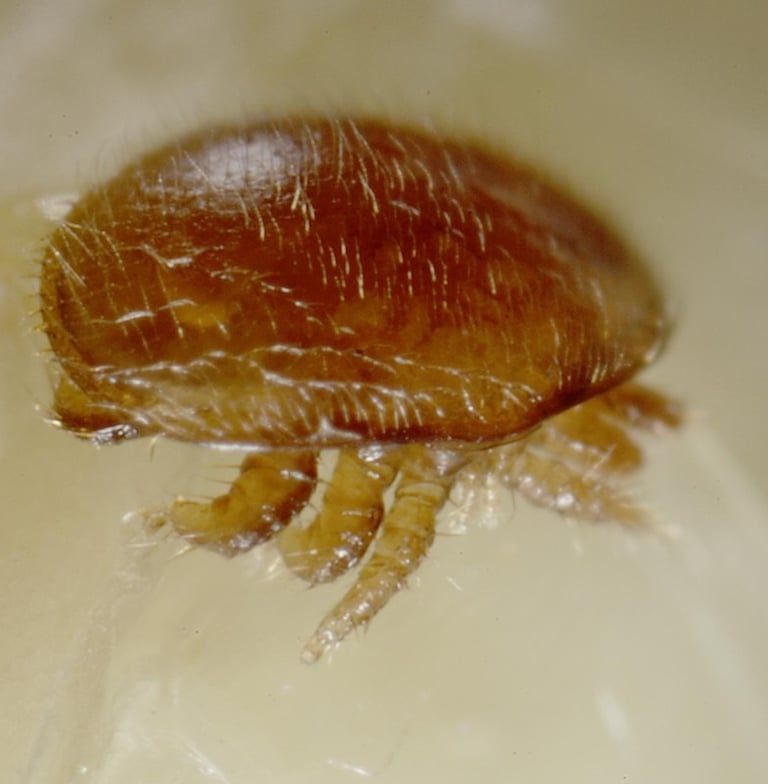
"Courtesy The Animal and Plant Health Agency (APHA), Crown Copyright"
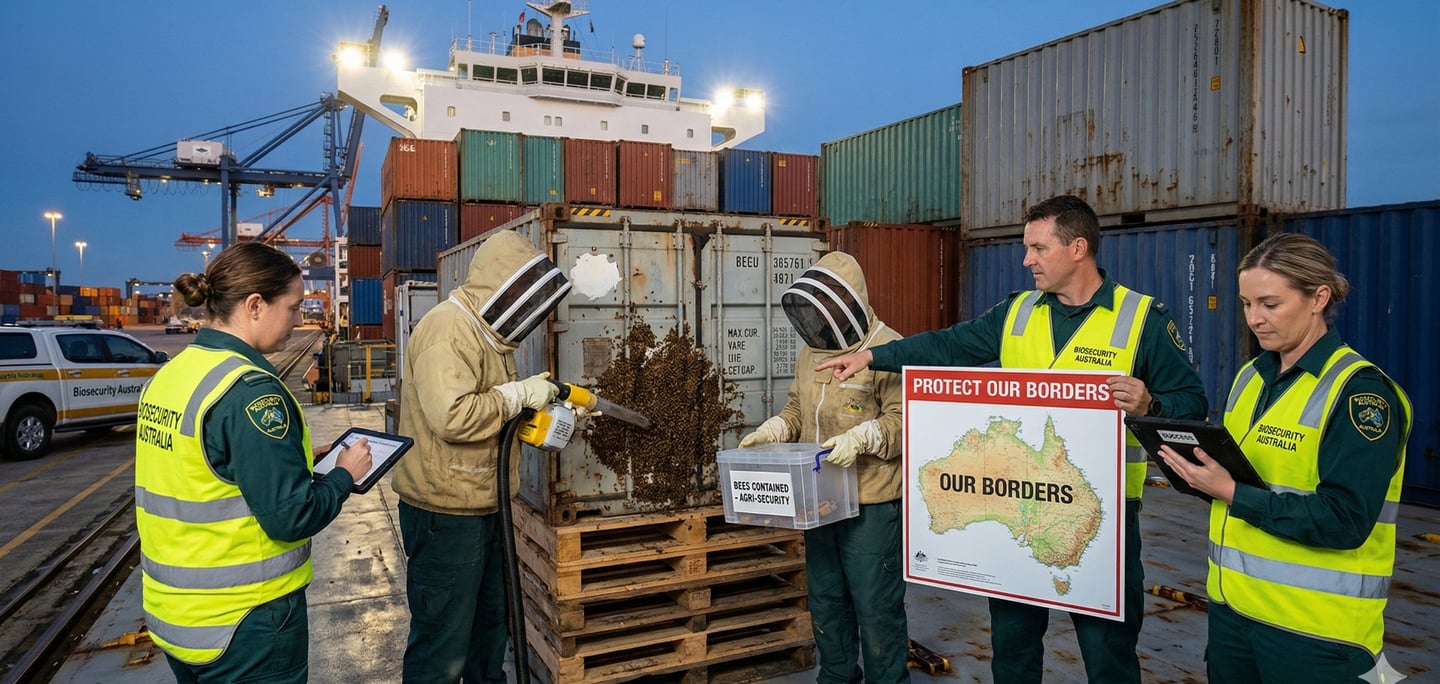
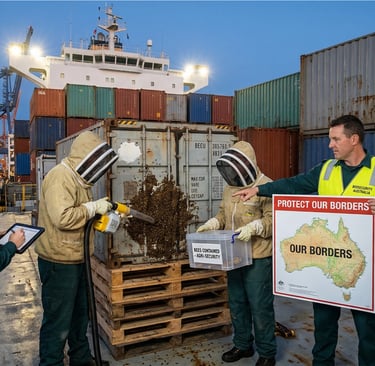
Protect Australia's Borders
The fight against biosecurity breaches requires public vigilance. If you have any information regarding potential breaches of Australia’s biosecurity laws, contact the Department of Agriculture, Fisheries and Forestry (DAFF) via the REDLINE reporting service at 1800 803 006.
Melli Magic Honey®
+61-411234759
Melli Magic Honey® © 2026. All rights reserved.
ABN: 65366959676
149 The Grand Parade, Monterey, NSW, 2217