✅ "Pharmacy-trusted since 2013, now delivering Australia's rarest raw honeys direct to your door."
Varroa Mite Testing Australia: Why the Triple Alcohol Wash is the 2026 Gold Standard
The 2026 Varroa Siege: Intro
"Protect your hives from Varroa destructor. Learn how to identify, monitor, and manage Varroa mites with our comprehensive 2026 Varroa destructor guide." Start your mite check today because Varroa isn't a 'maybe'—it's a 'when!
In the 2026 beekeeping landscape, "guesswork" is a luxury no Australian hive can afford. As the L925I mutation—widely known as the "Super Mite"—spreads across the continent, traditional monitoring methods like sticky boards are failing to provide the accuracy needed for survival. To defend your apiary, you must transition from casual observation to high-precision data. The Triple Alcohol Wash has emerged as the 2026 gold standard, offering a 95–100% recovery rate that other tests fall short of. By understanding the mechanical science behind this protocol, beekeepers can bypass chemical resistance and gain a crystal-clear view of their infestation levels before a colony collapse becomes inevitable.
The "False Sense of Security in 2026": Why the L925I Super Mite Stays Invisible
Don't Fall into a "False Sense of Security" in 2026
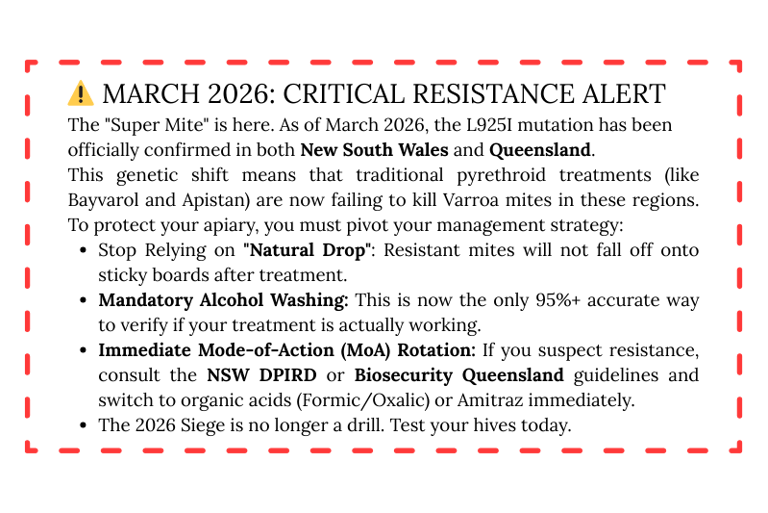
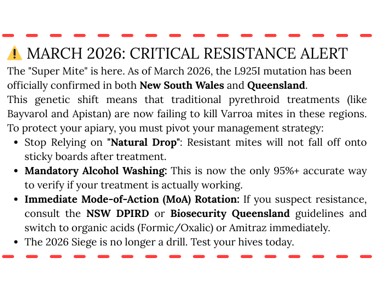
In 2026, the L925I mutation (the Super Mite) has made mites more resilient.
Under-Counting: Because these mites are healthier and better adapted to survive in Australian hives, the "natural drop" rate is often much lower than the actual infestation level.
The Danger: You might see only 2 or 3 mites on your sticky board and think you are safe. However, because these mites aren't dying from traditional treatments, there could be thousands hidden under the sternites, actively destroying the fat body tissue."The bottom line for Australian beekeepers in 2026 is clear: Alcohol washing is the only monitoring method with the 95%+ accuracy required to detect the L925I Super Mite before colony collapse occurs."
A sticky board measures mortality, but an alcohol wash measures the invasion."
In a "Siege," you don't count the enemies who died at the gate; you count the ones currently inside the walls. So, if you're not washing, you're just guessing.
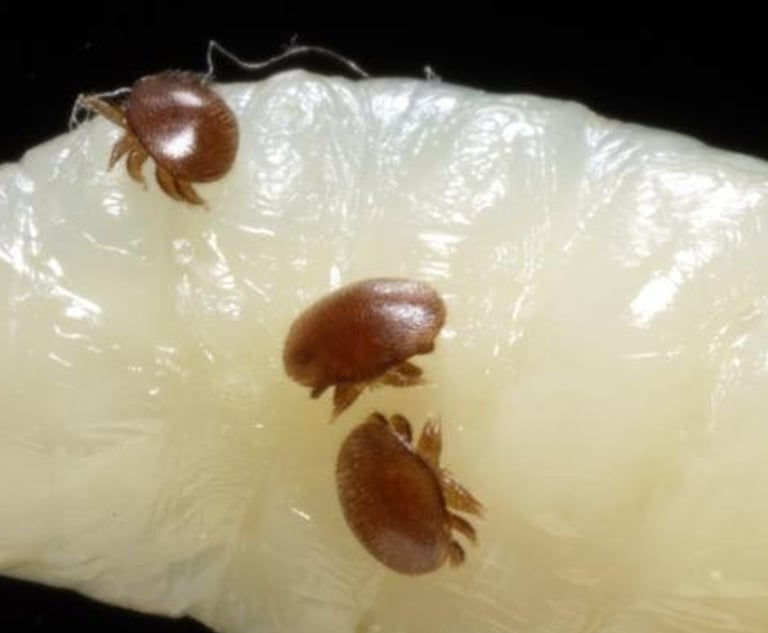
"Varroa Destructors on Honeybee Larvae, Crown Copyright"
The Triple Alcohol Wash is the Recommended Golden Standard!
In 2026, the "Alcohol Wash 3-Step Rule" is the gold standard for Australian beekeeping. Recent studies have confirmed that a single wash recovers only about 70% of mites, whereas performing three consecutive washes on the same 300-bee sample yields over 95% accuracy. This is critical for detecting the L925I "Super Mite" before it triggers a colony collapse.
Here is the exact procedure to ensure you aren't falling into a "false sense of security."
Preparation: The "Nurse Bee" Target
Target: Select a frame from the brood nest (preferably with open larvae). This is where the nurse bees are, and they carry the highest concentration of mites.
The Queen Check: CRITICAL. Ensure the queen is not on the frame. If you find her, move her to a safe frame or cage her during the test.
The Sample: Use a 1/2 cup (125 mL) measuring scoop to collect about 300 bees. Tap the frame over a tub and scoop them from the corner.
The Triple-Wash Procedure
To achieve 95%+ accuracy, you must use the same sample of bees for all three steps, but you will strain the liquid between each wash.
Wash 1: The Kill & Initial Release
Place the 300 bees in your shaker jar and cover them with 75% Methylated Spirits or Rubbing Alcohol.
Vigorously shake/swirl for 15–20 seconds. The goal of the first wash is to kill the bees and mites instantly and begin the separation.
Pour the alcohol through a fine mesh (which holds the bees) into a white container.
Count the mites captured on the mesh or in the white container.
Wash 2: The Deep Dislodge
Pour the same alcohol (or fresh liquid if it’s too cloudy) back into the jar with the same bees.
Vigorously shake again for 15–20 seconds.
This wash dislodges mites that were trapped in the "bee hair" (setae) during the first round.
Strain and count the additional mites.
Wash 3: The Final Verification
Repeat the process one last time with the same bees.
A third wash is essential for catching the L925I mutation mites, which have been shown to adhere more stubbornly to the bees' sternites.
Strain and count. Your total mite count is the sum of all three washes.
Calculating Your 2026 Threshold
Once you have your total count from the three washes:
Divide the total by 3 to get your percentage of infestation.
Example: 9 mites total ÷ 3 = 3% Infestation.
2026 Alert: If your total count is 3 or more mites (1%), the national recommendation is to implement your Integrated Pest Management (IPM) plan immediately. If you find even one mite in a previously clean area, you must report it via the Bee 123 form within 24 hours.
Why 3 Washes?
A single wash is often "too little, too late." By the time a single wash shows 5 mites, the actual infestation might be closer to 15. The 3-wash method ensures you are seeing the true invasion level, not just the "easy to find" mites.
In the 2026 beekeeping landscape, "guesswork" is a luxury no hive can afford. To understand why we advocate for the alcohol wash, we have to look at the hard data through two lenses: efficiency and evolution.
The 95% Truth
Data from peak bodies like the Elizabeth Macarthur Agricultural Institute (EMAI) and researchers like Dr Samuel Ramsey confirm reality: while a "sticky board" or a quick visual check might miss more than half of your infestation, the alcohol wash delivers a 95–100% recovery rate.
The "Super Mite" Blind Spot
The arrival of the L925I mutation in March 2026 has rendered traditional "treatment drop" counts obsolete. Since these Super Mites are genetically shielded against pyrethroids, a chemical strip won’t make them fall. They stay latched to the bees, invisible and active.
Because alcohol washing is a mechanical separation, not a chemical one, the mite’s pesticide resistance is irrelevant. The alcohol dissolves the "suction" of the mite’s feet, physically stripping the invader from the bee regardless of its genetic makeup. The 3-Step Alcohol Wash Protocol (2026 Standard)
To defend your hive, you must move beyond guessing. This protocol is the "Gold Standard" for Australian beekeepers navigating the current siege. Before you begin, ensure you have a standard mite wash jar and a bottle of 70%+ Isopropyl Alcohol or Methylated Spirits.
"Watch: 2026 Varroa Mite Alcohol Wash Video Tutorial"

The "Accuracy Warning"
Alcohol Wash: 95–99% Accuracy (The Gold Standard)
Soapy Water Wash: 90–95% Accuracy (Reliable but lethal)
Sugar Shake: 80–90% Accuracy (Non-lethal but weather-dependent)
Other Alternatives
The Soapy Water Wash (The Best Chemical Alternative)
If you cannot source 70%+ isopropyl alcohol or methylated spirits, Soapy Water is the most effective substitute. In fact, many commercial operations have switched to this because it is cheaper and non-flammable.
The Solution: Mix 2 tablespoons of low-suds detergent (like a professional windscreen washer fluid or a specific low-foam dish soap) per 1 litre of water.
Why it works: The soap breaks the surface tension of the water and the "suction" of the mite's feet (pretarsi).
The Catch: Like the alcohol wash, this is a lethal test for the 300 bees in your sample.
SEO Tip: Use the term "Low-Foam Detergent Wash" in your headers, as "soapy water" can sometimes produce too many bubbles, making it impossible to see the mites at the bottom of the jar.
The Sugar Shake (The Non-Lethal Alternative)
The Sugar Shake (or Sugar Roll) is the preferred method for beekeepers who do not want to sacrifice bees during testing.
The Solution: Use Pure Icing Sugar (Powdered Sugar). Do not use an icing mixture that contains cornstarch, as it can clump and harm the bees.
How it works: The fine dust of the sugar prevents the mite's suction-cup feet from gripping the bee's cuticle. The bees also begin "grooming" vigorously, which helps dislodge the mites.
The Drawback: In 2026, the Sugar Shake is considered less accurate than a wash. High humidity or a heavy nectar flow can cause the sugar to turn into a sticky mess, trapping the mites on the bees instead of releasing them.
90% as effective as an alcohol wash. For the L925I Super Mite, an alcohol wash is still the recommended choice for confirmed accuracy.
Breaking the "Suction" Physically, the mite uses suction-cup feet called pretarsi to lock onto the bee's smooth exoskeleton.
The "Dusting" Effect: The fine particles of the pure icing sugar (powdered sugar) act like a dry lubricant. The sugar coats both the bee and the mite, clogging the mite’s "suction cups."
The Result: The mite can no longer maintain its grip on the slippery bee cuticle. When you shake the jar, the mites tumble off through the mesh, while the bees remain unharmed inside.
Stimulating the "Grooming for Vigorous Cleaning: When a bee is covered in sugar, it immediately begins "aut grooming" (cleaning itself) and "allogrooming" (cleaning its neighbours).
The Result: This frantic movement helps physically knock the mites loose. The heat generated by the bees' movement also makes the mites more active and less stable, causing them to fall off more easily.
The Melli Magic Verdict: Use the Sugar Shake if you are a hobbyist with only one or two hives and are testing frequently. However, if you see any signs of wing deformity or spotty brood, move to an Alcohol Wash immediately for 100% certainty.


Our mission
We're on a mission to change the way the housing market works. Rather than offering one service or another, we want to combine as many and make our clients' lives easy and carefree. Our goal is to match our clients with the perfect properties that fit their tastes, needs, and budgets.
Our vision
We want to live in a world where people can buy homes that match their needs rather than having to find a compromise and settle on the second-best option. That's why we take a lot of time and care in getting to know our clients from the moment they reach out to us and ask for our help.


Our team
Our strength lies in our individuality. Set up by Esther Bryce, the team strives to bring in the best talent in various fields, from architecture to interior design and sales.


Esther Bryce
Founder / Interior designer


Lianne Wilson
Broker


Jaden Smith
Architect


Jessica Kim
Photographer
Melli Magic Honey®
+61-411234759
Melli Magic Honey® © 2026. All rights reserved.
ABN: 65366959676
149 The Grand Parade, Monterey, NSW, 2217